Beyond Bigger Models: EfficientNet’s Smart Approach to Scaling Neural Networks
An exploration of how EfficientNet revolutionized neural network scaling by replacing arbitrary depth/width expansion with compound scaling (phi).
Originally published on Medium by Firoj Paudel.
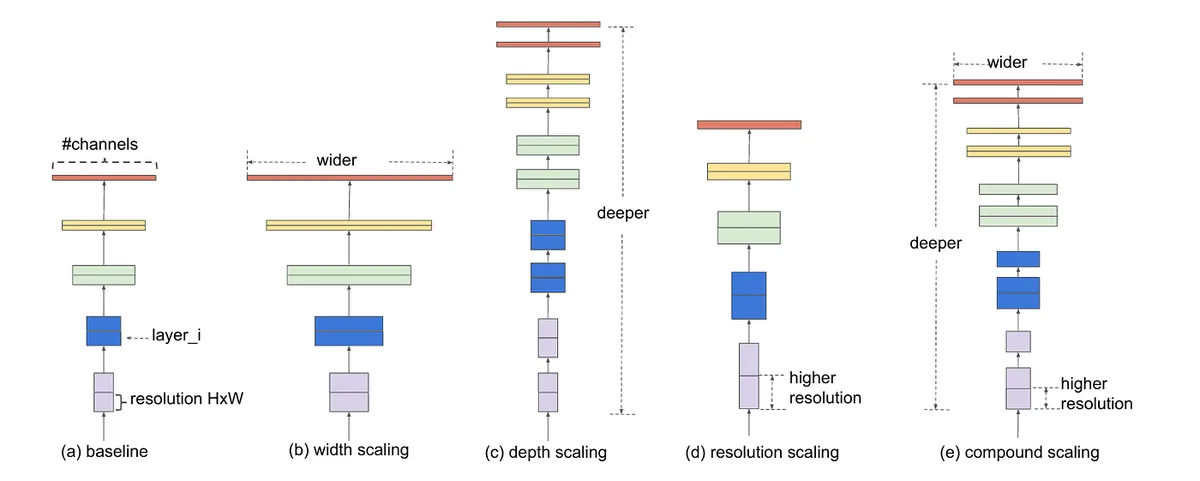
Scaling up convolutional neural networks has traditionally been an unguided trial-and-error process. Practitioners often scale depth (adding more layers), width (increasing channel dimensions), or input image resolution in isolation. However, scaling a single dimension yields diminishing returns and quickly hits hardware compute bottlenecks.
EfficientNet introduced Compound Scaling: a systematic approach to scale network depth, width, and resolution simultaneously using a fixed set of scaling coefficients.
The Problem with Single-Dimension Scaling
- Depth (): Deeper networks capture richer features, but vanishing gradients make training hard, and accuracy gains saturate quickly.
- Width (): Wider networks capture fine-grained features, but extremely wide and shallow networks struggle with complex abstractions.
- Resolution (): Higher resolution images provide finer detail, but computational cost grows quadratically ().
Compound Scaling Formulation
EfficientNet unifies scaling using a user-defined compound coefficient :
where are constant coefficients determined by a small grid search on the baseline architecture (EfficientNet-B0), subject to:
Why EfficientNet Matters
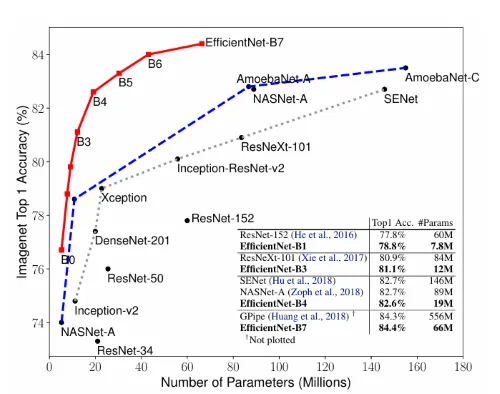
- EfficientNet-B7 achieved 84.3% top-1 accuracy on ImageNet while being 8.4x smaller and 6.1x faster on inference than ResNet-152.
- It demonstrated that smart, balanced parameter allocation outranks raw brute-force model size when deploying vision models under real hardware constraints.