Deep Residual Learning for Image Recognition: A Fresh Look
Analyzing ResNet skip connections, residual formulation F(x) + x, and how identity mappings enable training deep architectures without degradation.
Originally published on Medium by Firoj Paudel.
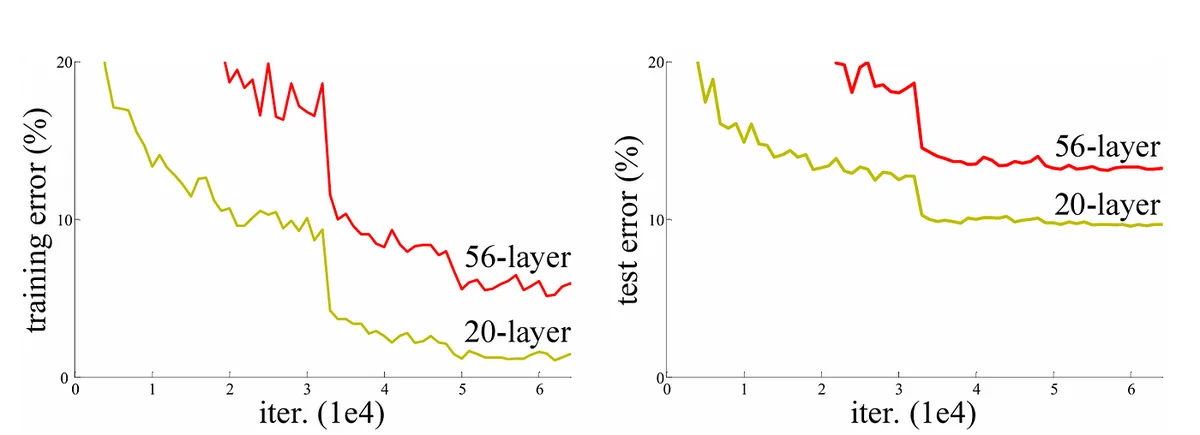
Before He et al. introduced Residual Networks (ResNet) in 2015, stacking more layers onto a deep network caused a surprising paradox: training accuracy began to degrade rather than improve, even when overfitting was ruled out.
The Degradation Paradox
If a shallow network achieves a certain performance, a deeper network ought to perform at least as well, because the extra layers could theoretically learn identity mappings. In practice, standard feedforward layers struggle to learn identity functions using unconstrained weight matrices.
The Residual Learning Formulation
Instead of fitting an underlying mapping directly, ResNet reformulates the target as a residual function:
Through shortcut / skip connections, the network only needs to learn the residual error . If an identity mapping is optimal, the optimizer simply drives weights towards zero ().
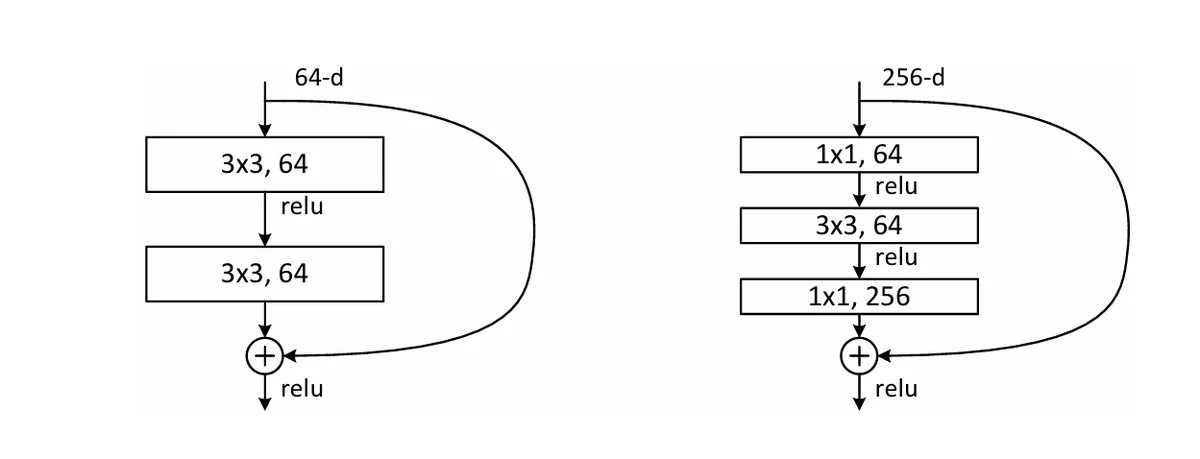
import torchimport torch.nn as nn class ResidualBlock(nn.Module): def __init__(self, in_channels, out_channels, stride=1): super().__init__() self.conv1 = nn.Conv2d(in_channels, out_channels, kernel_size=3, stride=stride, padding=1, bias=False) self.bn1 = nn.BatchNorm2d(out_channels) self.relu = nn.ReLU(inplace=True) self.conv2 = nn.Conv2d(out_channels, out_channels, kernel_size=3, stride=1, padding=1, bias=False) self.bn2 = nn.BatchNorm2d(out_channels) self.shortcut = nn.Sequential() if stride != 1 or in_channels != out_channels: self.shortcut = nn.Sequential( nn.Conv2d(in_channels, out_channels, kernel_size=1, stride=stride, bias=False), nn.BatchNorm2d(out_channels) ) def forward(self, x): residual = self.shortcut(x) out = self.relu(self.bn1(self.conv1(x))) out = self.bn2(self.conv2(out)) out += residual # Skip connection addition return self.relu(out)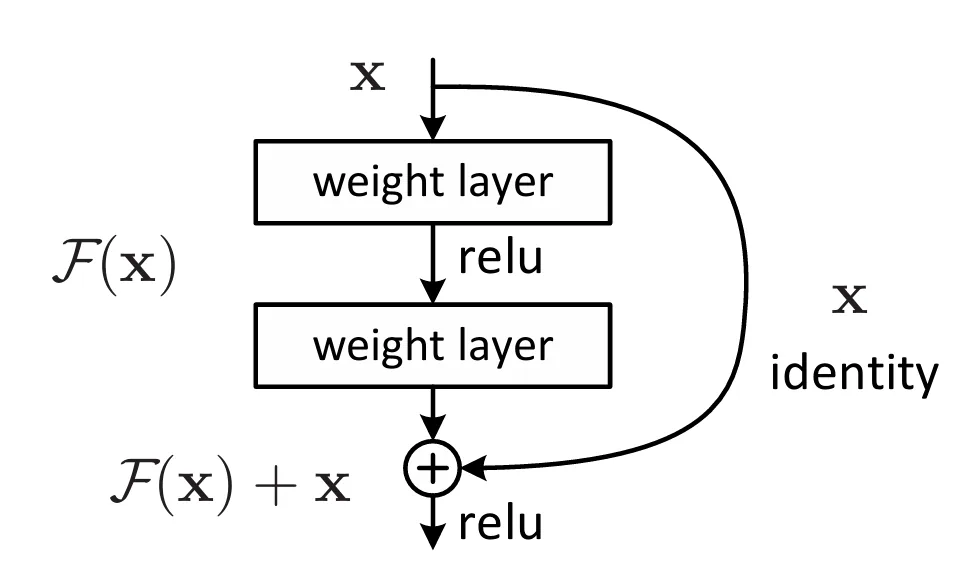
Why Skip Connections Change Gradient Highway Dynamics
During backpropagation, the gradient with respect to activation is:
Notice the constant term 1. It guarantees that gradients can flow unimpeded directly from layer to layer , preventing vanishing gradients even in networks exceeding 1,000 layers.