I trained a speech model on less than an hour of fake audio. It held up on real podcasts.
Building a Nepali–English code-switched podcast benchmark, generating 0.95 hours of synthetic training speech, and why GRPO barely mattered after SFT.
Put on any Nepali podcast and count how often the speaker drops into English. You'll lose count in about a minute. In the benchmark I ended up building, about one in every three words is English, and the average utterance switches language more than twice. That's just how people talk now, especially in Kathmandu, especially on tech, business and education shows.
Speech recognition models hate this. And honestly, I get it. Most of them were trained on one language at a time, so a sentence that jumps scripts every few words is a mess for them.
So I wanted to answer a pretty simple question: can I teach a model to handle this using audio I generate myself, without spending months recording and labeling real people? Turns out, mostly yes. Here's how it went, including the parts that didn't work.
Why mixed speech breaks ASR
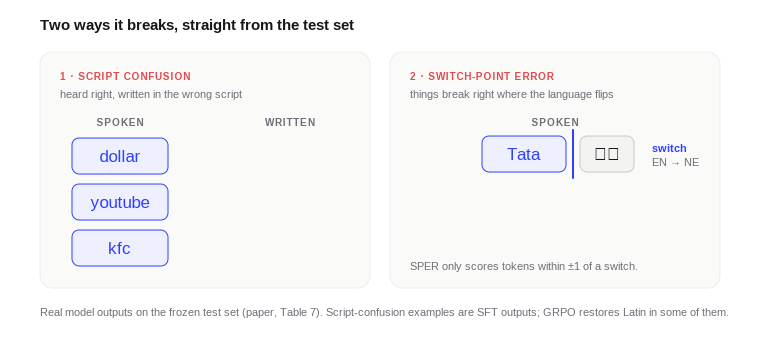
When Nepali and English share one sentence, models fail in two very specific ways.
Script confusion. Nepali is written in Devanagari and English in Latin script. The model hears "doctor" and writes डक्टर, spelling the English word out in Nepali letters. Or the opposite: it writes a Nepali word in Latin. Either way the transcript is wrong even if the sounds were heard right.
Switch-point brittleness. Right at the boundary where the speaker flips language, everything falls apart. Insertions, deletions, substitutions, all piling up in the one or two words around the switch.
To actually measure the second one, I used a metric I call SPER (switch-point error rate): the same error rate, but only counted on tokens within one token of a language switch. Regular WER hides this problem because most words aren't near a switch. SPER puts a spotlight on exactly where it hurts.
First problem: there was no benchmark
You can't fix what you can't measure, and there was no real benchmark for spontaneous Nepali–English speech. So I built one from public Nepali podcasts on YouTube.
The first pass came from automatic transcription with timestamps and speaker diarization. Then two bilingual annotators went through every single clip against the audio. That cleanup was humbling:
- 233 clips quarantined because they were music or audio loops
- 161 cases of "translation leakage", where spoken Nepali had been quietly written down in English
- 819 timestamp overlaps from diarization that doubled tokens
- 86 numbers like "2024" rewritten as the words actually spoken
On a separate 500-clip sample, the two annotators agreed on 98.4% of characters.
What came out the other end: 13,044 utterances, 15.45 hours, 28 episodes, 72 speakers and 29,033 switch points. About a third of all words (32.7%) are English. I split it into a 3.55-hour dev set and an 11.90-hour test set that I froze and never trained on. No speaker appears in both.
One convention that matters a lot: English stays in Latin script exactly as spoken, and Nepali postpositions stuck onto English words get split off. So "phone मा", not "फोनमा".
Making fake podcasts
Now the fun part. Instead of collecting more real speech, I generated it.
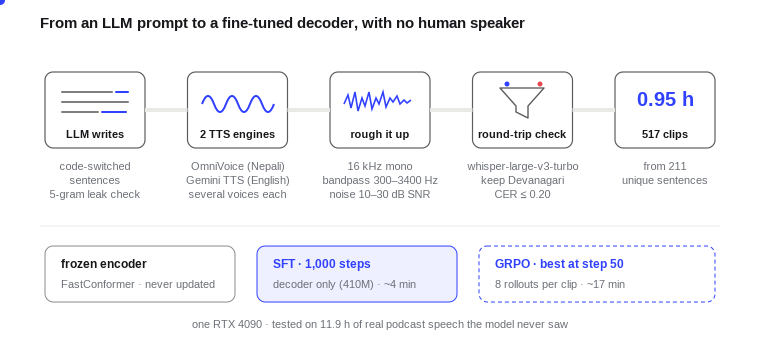
First, an LLM (Gemini 3.8 Flash) wrote conversational sentences with natural mid-sentence switching, the way people actually talk about startups, tech and college. I filtered those hard and ran a 5-gram check against the benchmark so none of the test sentences could leak into training.
Then two TTS engines turned the text into speech: OmniVoice, fine-tuned on 100+ hours of native Nepali speech, and Gemini's multi-speaker TTS for English voices. Every sentence was rendered in several voices with both engines.
Clean TTS sounds nothing like a podcast, so I roughed it up: 16 kHz mono, a telephone-style bandpass filter (300–3400 Hz), and background noise at 10–30 dB SNR.
Last step, a sanity filter. I ran every clip back through a separate model, whisper-large-v3-turbo, and kept only the ones where the Devanagari part came back with a character error rate of 0.20 or less. If an independent recognizer couldn't understand a clip, I didn't want my model learning from it. (Whisper is only the filter here. The model I actually fine-tuned is a different one, coming up next.)
Final count: 211 unique sentences, 517 clips, 0.95 hours. That's it. Less than an hour.
Training: SFT first, then GRPO
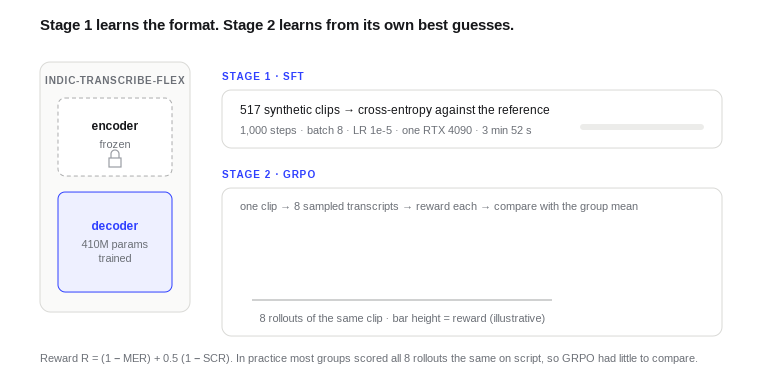
The base model is indic-transcribe-flex, a 1.22B-parameter encoder–decoder built on Canary-1B-v2. I froze the whole encoder and only trained the decoder, which is about 410M parameters (33.6% of the model).
Stage 1: teach it what mixed speech looks like (SFT)
Nothing fancy here. Plain cross-entropy on the 517 synthetic pairs, so the decoder learns to write English in Latin and Nepali in Devanagari inside the same sentence.
- 1,000 steps, batch size 8, peak learning rate 1e-5 with cosine decay
- one RTX 4090, FP16
- wall clock: 3 minutes 52 seconds
Stage 2: let it compete with itself (GRPO)
Starting from the SFT checkpoint, for every clip the model samples 8 different transcripts. Each one gets a reward, the group's average becomes the baseline, and the model is pushed toward the transcripts that beat the average and away from the ones that didn't. No separate value model, no human labels, just the group grading itself.
The reward for each transcript:
MER is the mixed error rate (word errors on the English parts plus character errors on the Devanagari parts), and SCR is the script confusion rate. With , a transcript earns extra credit for putting each word in the right script.
- 8 rollouts per clip, 4 clips per batch (32 transcripts per update), sampling temperature 1.0
- learning rate 1e-6, PPO clip 0.2, no KL penalty
- 500 steps, checked every 50, about 17 minutes
I also tried a third idea as a baseline: a small "script gate" head that predicts, token by token, whether the next word should be Latin or Devanagari, and nudges the decoder accordingly.
The numbers
Here's everything on the frozen real test set: 10,214 utterances of real people talking, none of it synthetic.
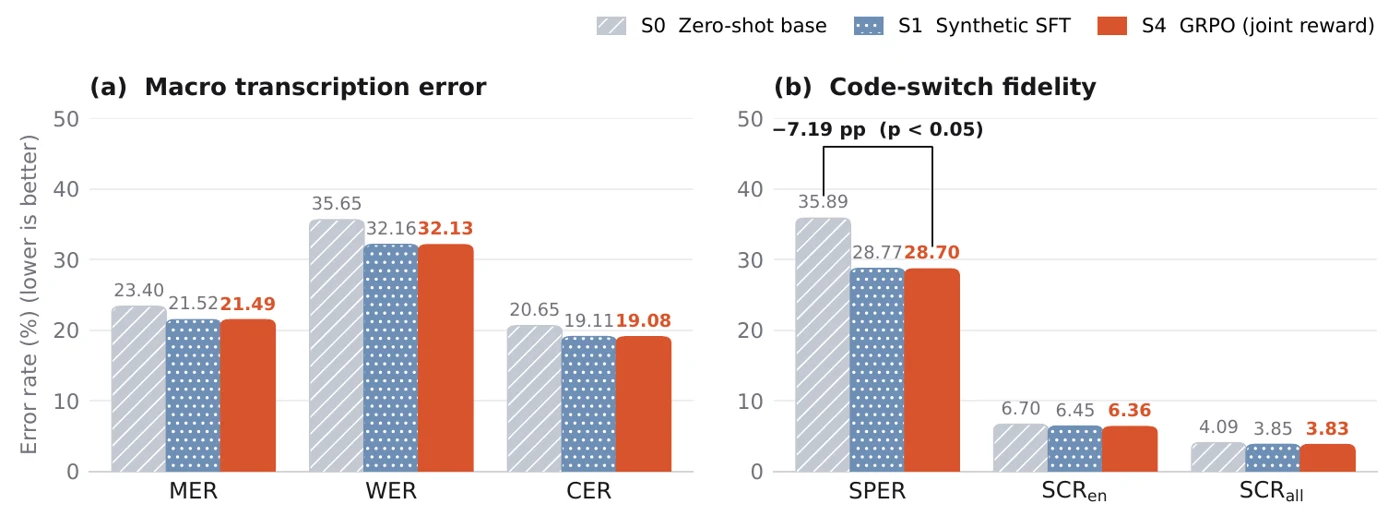
- Base model: MER 23.40 · WER 35.65 · SPER 35.89 · English script confusion 6.70
- + SFT on synthetic: MER 21.52 · WER 32.16 · SPER 28.77 · English script confusion 6.45
- + GRPO: MER 21.49 · WER 32.13 · SPER 28.70 · English script confusion 6.36
The headline is the SPER column. Errors right at the language switches dropped from 35.89% to 28.70%, a 7.19-point drop with a 95% confidence interval of [−7.97, −6.46]. Overall MER dropped 1.90 points. All from under an hour of audio that no human ever spoke.
What didn't work (and it's the interesting part)
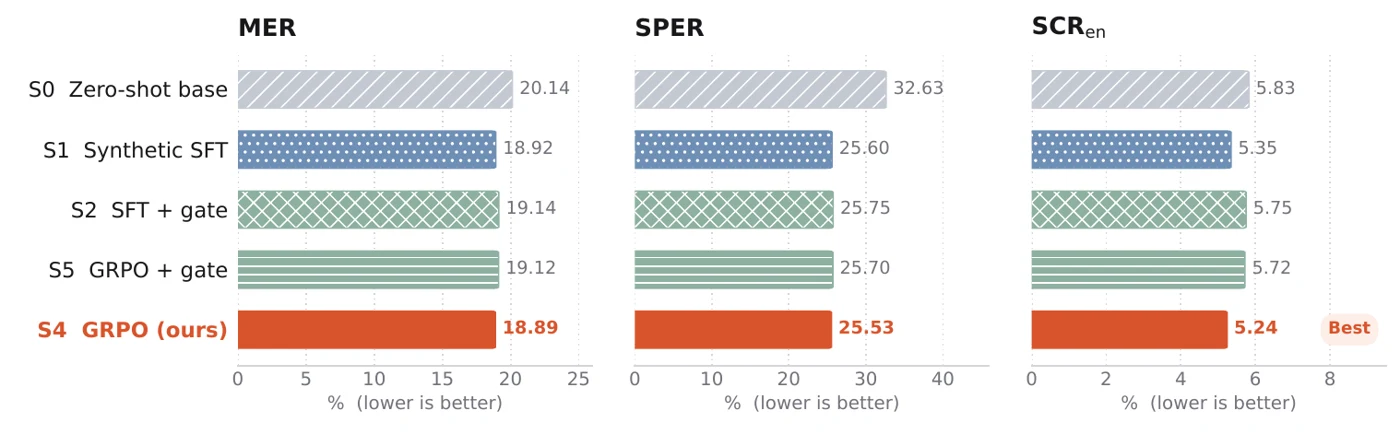
The script gate made things worse. On dev, adding it pushed MER from 18.92 to 19.14 and English script confusion from 5.35 to 5.75. Forcing token-level decisions into an autoregressive decoder just seems to get in the way.
The script reward did literally nothing. The GRPO run with the script reward and the one without it produced identical dev numbers. When I dug in, the reason was kind of funny: in more than 75% of mini-batches, all 8 sampled transcripts had the exact same script mistakes. GRPO learns from the differences inside a group, so if every rollout is equally wrong, there's no signal to learn from.
GRPO's gains were tiny. Out of 10,214 test utterances, GRPO changed the output on exactly 173 (1.69%). The other 10,041 were word-for-word identical to SFT. The improvements are statistically significant, but they're a fraction of a point. The best checkpoint was step 50, and after step 200 the synthetic dev error actually crept up.
And to be fully honest: I didn't run an SFT baseline with the same extra compute, so I can't say for sure whether that small gain comes from GRPO itself or just from more training steps.
Things that bit me
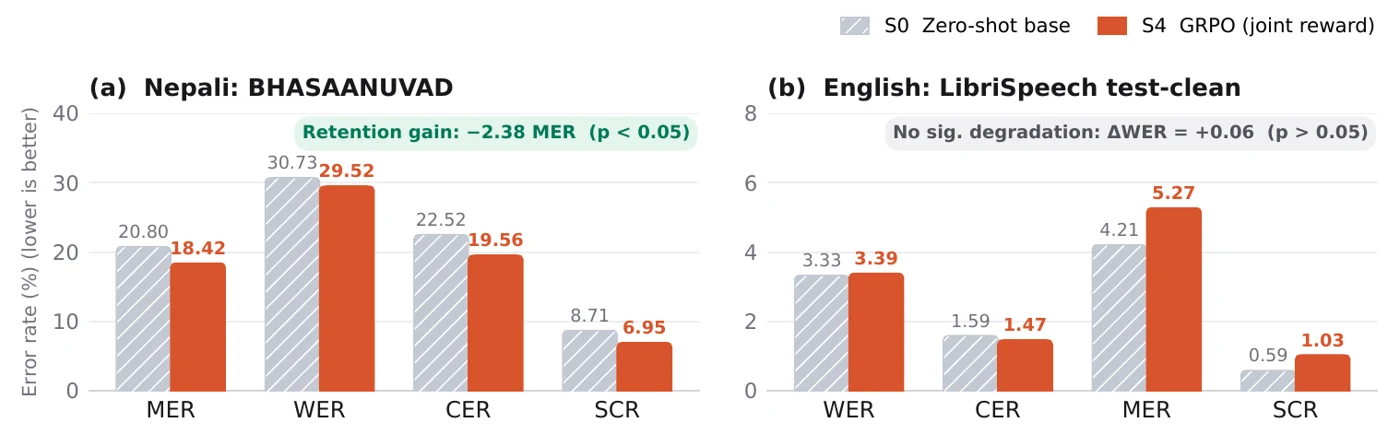
WER can lie to you. On English LibriSpeech, WER barely moved (3.33 to 3.38, not significant). Looks great, right? But MER went from 4.21 to 5.27 and script confusion from 0.59 to 1.03, because the model started sneaking Devanagari characters into pure English speech. That came from SFT, not GRPO. If I'd only reported WER, I'd have missed it completely.
Fine-tuning can erase rare words. The base model transcribed "opex" correctly. After SFT it became "open expenditure". Small synthetic datasets push the model toward the words they contain, and rare words outside them can get overwritten.
But sometimes it fixes exactly the right thing. SFT turned "Tata को" into "टाटाको", gluing the brand name onto the postposition. GRPO split it back into "tata" + "को", which is exactly the convention I wanted.
What I'd do differently
- More voices. 517 clips with only a few TTS timbres is tiny. I'd scale the voice variety before scaling anything else.
- Unfreeze the encoder. A frozen encoder probably caps how much the decoder (and GRPO) can fix.
- Run the boring controls. Multiple seeds, an SFT run with matched compute, and comparisons against external models like Whisper. They aren't in this paper and they should be.
- Watch for reference bias. The first-pass transcripts came from an automatic system before humans corrected them. 98.4% agreement is good, but some bias can survive that.
Wrapping up
The thing I keep coming back to: less than an hour of generated speech, about 4 minutes of training on one GPU, and errors at language switches dropped by more than seven points on real podcasts. For languages where nobody is going to fund thousands of hours of transcribed mixed speech, that's a pretty hopeful result.
Everything is open:
- Paper: arxiv.org/abs/2610.30860
- Code: github.com/Firoj-Wise/nepali-english-codeswitch-asr
- Dataset: huggingface.co/datasets/SamaFiroz/nepali-english-codeswitch-podcasts
The audio itself isn't redistributed. The release has transcripts, timestamps, YouTube IDs and checksums, plus a tool that rebuilds the exact clips on your machine.